Without electricity, an ultrasound scanner does not work. Without connectivity, a village pupil does not have the same lessons as a pupil in Dakar, and a grower does not know the market price. TUMIQUI JAPON SASU starts from this observation, made in the villages of Senegal since 2019.
The TUMIQUI pyramid
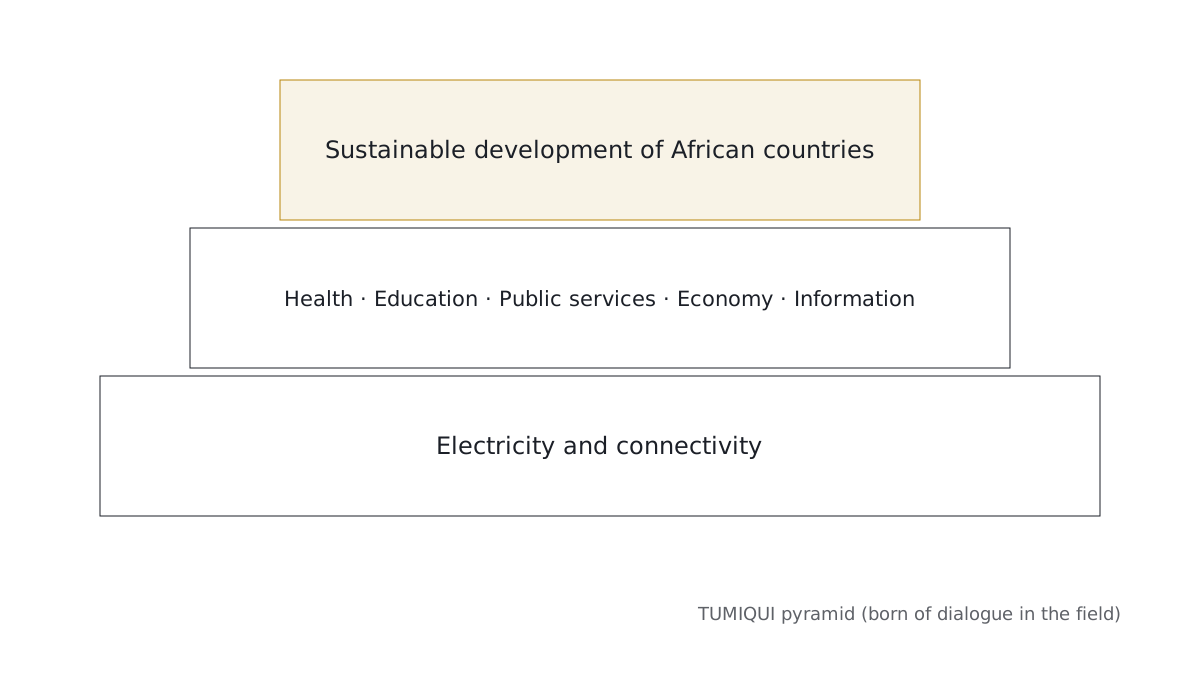
Conversations with residents, nurses, teachers and Senegalese administrations produced a simple model, which we call the TUMIQUI pyramid.
| Level | Content |
|---|---|
| Top | Sustainable development of African countries: communities that learn, work, receive care and raise the next generation without depending on aid |
| Middle | The services that make this possible: health, education, administration, economy, information |
| Base | Electricity and connectivity, on which every level above depends |
This is why TUMIQUI JAPON SASU delivers electricity and connectivity together, and always with the equipment that serves one specific level: a television for the classroom, a printer for the health post, a cold room for the harvest.
Education: 31% to 77%
At the first school equipped in Senegal, the pass rate for the primary school leaving certificate rose from 31% to 77% the following year. The school did not change its teachers or its pupils. It plugged a television into a Smart Kit and showed the Ministry of National Education’s teaching content. A teacher said: “You just put the USB stick in the television.”
This result led to the deployment of 147 kits in 122 schools in The Gambia with UNICEF.
Health: working at night
In health posts without electricity, consultations stopped at nightfall and night deliveries were done by torchlight. With a Smart Kit, the post stays open at night, charges its devices and sends its reports without closing for a day. In 2019, the group electrified 10 health posts. More than 600 deliveries have since taken place there with electricity. In Casamance, a printer connected to the kit replaced the boat trip to town for a photocopy. A health post manager said: “We can work at night now.”
Economy: the harvest no longer rots
About 50,000 tonnes of mangoes are lost every year in Senegal. In Sandiara, two solar cold storage sites keep the harvest and the women’s group GIE DIAMI SANDIARA processes mangoes into products that sell all year round. The women have been trained in hygiene, temperature control and lot recording. The products are being promoted in Japan and France, and sample shipments to Japan have begun.
With the Senegalese State
Three ministries have signed a memorandum of understanding with the group: Health and Social Action, National Education, Industry and Commerce. The schools and health posts equipped are chosen with the State services. The Sandiara sites were built with the town council.
What we measure
TUMIQUI JAPON SASU publishes only figures it can document: units delivered, sites in service, school results observed, hours of operation. Testimonies are collected on site, with the person’s position.