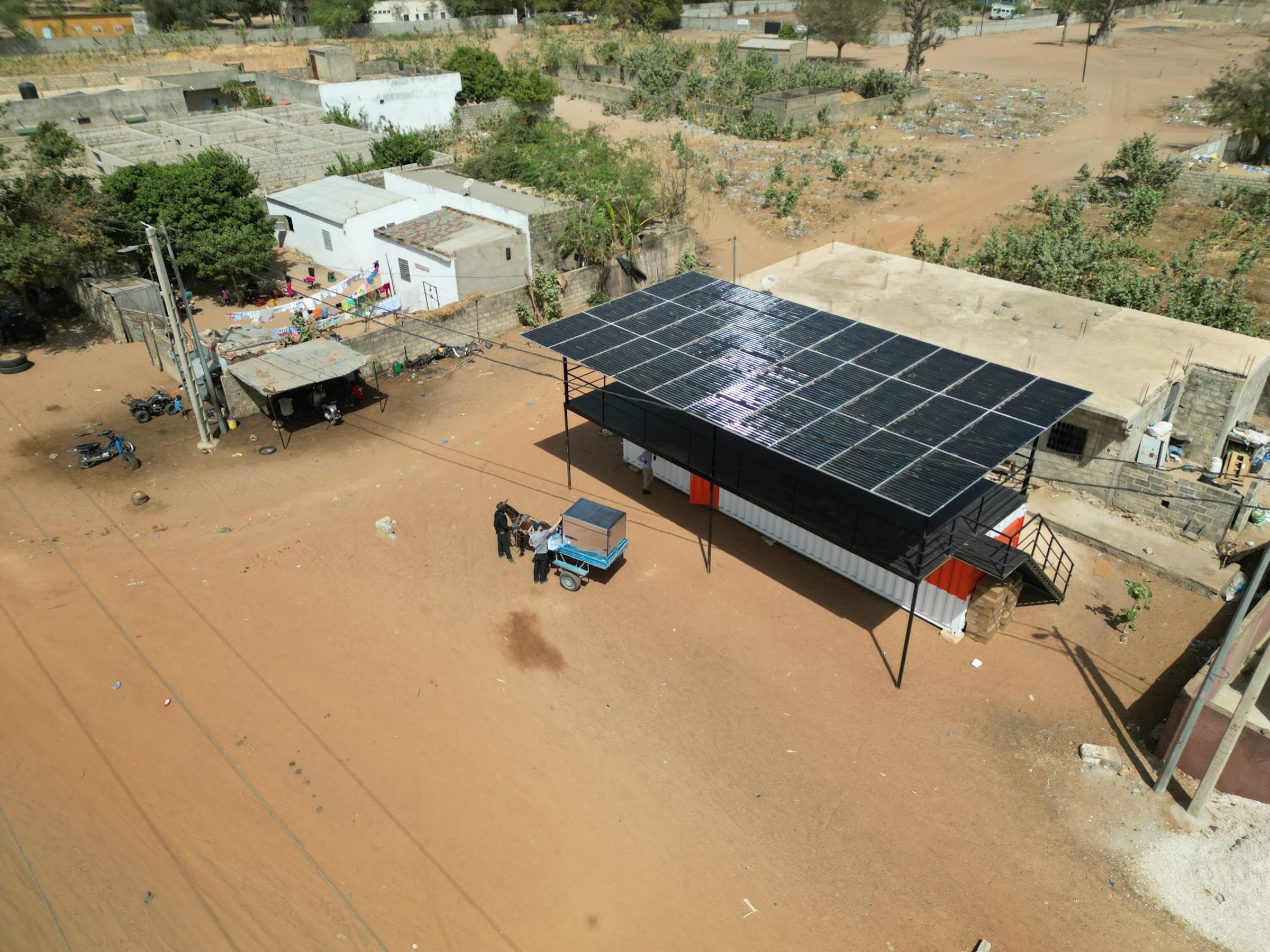
In Senegal, about 50,000 tonnes of mangoes are lost every year. The fruit ripens at the same time, from May to August, and there is no cold room near the orchards. In Sandiara, Thiès region, TUMIQUI JAPON SASU built two sites to address this problem. Both run on solar power and batteries only, day and night.
In figures
| Site A | Site B | |
|---|---|---|
| Configuration | One insulated 40-foot container | Three containers under a pitched roof |
| Solar | 21 kWp | 35 kWp |
| Cold | 22 m³, 2 to 8 °C | 60 m³, with a freezer room |
| Consumption | About 15 kWh a day | Not published (site being fitted out) |
| Use | Chilled storage, KIOSK | Chilled and frozen storage, processing |
| Commissioning | 2026 | In operation |
| Power supply | Solar and batteries only | Solar and batteries only |
Both sites are located in the Sandiara special economic zone. A memorandum of understanding was signed with the town and the zone in December 2019.
Site A: the cold room that holds with 15 kWh
Outside air exceeds 40 °C on some days. Under these conditions, Site A keeps 22 m³ between 2 and 8 °C with about 15 kWh a day. This comes from reinforced insulation and a Daikin inverter refrigeration unit. The site was commissioned in 2026 and has no grid connection.
Next to the cold room, a KIOSK offers phone charging, printing and cold drinks. Its first customer was a secondary school student on the way home, on a 45 °C day, before it had even opened.
Site B: from fruit to product
Site B adds freezing and a processing workshop. The women’s group GIE DIAMI SANDIARA processes mangoes there: washing, cutting, heat treatment, vacuum packing, freezing. The workshop is laid out as a one-way flow, so that raw material and finished product never cross. The women were trained in hygiene, temperature control and lot recording.
This processing is carried out under a pilot project of Japan’s Ministry of Agriculture, Forestry and Fisheries (MAFF). The products are being promoted in Japan and France. The first samples have been shipped to Japan.
How the sites were built
Construction of the sites drew on a pilot programme of Japan’s Ministry of Economy, Trade and Industry. The solar cold storage pilot is supported by a grant from the MOL Blue Ocean Fund (Mitsui O.S.K. Lines). Containers and equipment were received in Senegal and assembled by TUMIQUI JAPON SASU technicians. Temperature, solar output and battery level are monitored from Dakar and from Japan.
Visit, rent, build
Both sites can be visited by appointment. Cold space is rented to producers, cooperatives, processors and traders. The same configurations are offered for construction on the client’s land.